Friday, August 29, 2008

Summer Reading : Mars, a text!


Patrick Chapman's latest collection of poetry displays the characteristics which have earned him praise and recognition as one of the more interesting voices of his generation of Irish poets.

The poems in this volume - ranging as they do over broad periods of time and experience – can sometimes appear to be ‘quare bedfellows’. However, this is far from negative - if anything it emphasises the diversity and range of thought and expression in Chapman's poetry. Heated relationships, cold wars, inner and outer space all combine here to provide a backdrop for stories of the heart, mind and body in a collection that exhibits distinctly cinematic qualities. There's a touch of the Noir here - not unrelenting darkness - more highlighted angles and delineations of a gamut of memorable characters. We meet a Queen of her own private Gethsemane, a vampire-priest-ringmaster, as well as certain politicians and ‘vast and cool intelligences' opening church and shopping malls in virgin territories. Musicians and other cultural icons create a sinewy linkage between the poet and his environment.

Throughout, there's a healthy dose of surreal humour. However, one of the strengths of this collection is Chapman's ability to present humour without resorting to glibness. Here it is part of the full tableaux of human experience, woven into love, fear, bewilderment and hope. There's a fair deal of sex too.

Overall the writing is underpinned with a deceptively casual sense of craft (this is Chapman's fourth collection, following on from a recent book of stories. He's also written films and audio plays). Towards the end, the collection heads into (literally) darker waters. Immersion recurs as a theme along with various extinctions, such as the young fisherman in the poem What You Leave Behind, lost at sea while providing for his his family;

“In dying he has lumbered them with boat-wreck
And some lately settled fear an tí –
Squatting in the drowned man’s chair.”


At first, this collection charms with its immediate vibrancy - then merits re-reading to tap into some of the deeper currents at work below the surface of this skillful, considered writing.

More info here.

The SLANTy Clause


Myself and other IGI illustrators currently have an exhibition running at Ormeau Baths Galleries, Belfast. You can read all about it over on Scamp. SLANT is all about putting your own stamp on a favoured painting. The tagline is 'imitation : flattery or battery" and there's everything from straight homage to wholesale re-invention. My own painting (above) is based on Dali's Premonition of Civil War. It's ALL good - but some of my favourites are paintings by PJ Lynch, Kevin McSherry and Jonathon McHugh. Also at the same venue is The AOI's Images 31 exhibition, featuring the cream of UK illustration. So, well worth a visit! >>>>>>> UPDATE!!! You can now check out a step-by-step of the above image over here on the IGI blog SCAMP! Make sure and leave a comment!

Tuesday, August 26, 2008

Ronnie we hardly Drew ya!


Myself and a bunch of IGI illustrators have marked the recent passing of Ireland's most distinctive singing voice, Ronnie Drew, by putting pen to paper and coming up with a few nice scamps of the great man himself. Check em out here.

Friday, August 15, 2008

Dispatches

Written back in late 2007, but seems appropriate to the current Irish climates;

***

Dispatches

This morning, the patio is a chessboard
Drained of fight, a low contrast
Truce of gritty concrete squares

Slick under furniture pieces disarrayed;
Mouldering victims of a thuggish midnight squall.
Brick red when first assembled, inclemency
Has shrunk their ersatz teak to oldbone grey.

I know they've reached the rotting stage.

The last time they were used, not one
But two seats rent that sunny afternoon,
Their rundles detonating under laden
Celtic tiger arses, ambushed.

***

This poem featured, along with a few others, in issue 2 of Polluto - the 'Apocalypses and Garden Furniture' issue. Now there's a theme and a half - and how bizarre that I actually had a poem which fit nicely!

Monday, August 11, 2008

Jusslyktha! (ahurr, ahurr)


And on, and on, and on she kept flowin - the witch bin around before ma mother born! To turtle or not - this be the interrogative? I believe there's excellent value in real estate in Chelonia at the mo? (Limited designs tho.)

Clucksake!


Those damnable best intentions went a-wanderin' again; insulting ladyboys, got beaten up on the tube and had luggage redirected to reykjavik; ended up drinking in shoreditch with japanese kylie fans - hence the infrequency of posts of late. Didn't bother me though - stuck here at home ripvanwinklin' through the biblical deluge that is the Irish summer. Thank goodness for stumped fowl, I say!

Thursday, August 07, 2008

Raccoon in the Restaurant


The good people at the Evening Herald's HQ magazine (Hi Sue!) asked me to review Meridien Theatre Company's production 'Raccoon' which is currently running at Bewleys Café Theatre, during lunchtimes, until August 23rd. You can read that review here

This really is a very good show, so if you're in the Grafton Street area for lunch before the run ends, I'd recommend it highly. The writer is an American named Tom Hall and, based on this play, I'd think his short stories (I'm guessing he's written a few) should be well worth a read. That's if anybody knows where I might find them / him? According to the bumph, he's lived in Mexico, Cork & Wexford but is now based in Dublin. 'Raccoon' also features in a double bill 'The Lost Field' from Meridien - which will be touring nationwide this November - so keep your eyes peeled.

Meridien are a lively and innovative company, with some interesting work in their archive. Their forthcoming production is 'There Are Little Kingdoms' - a play based on the short story collection of the same name by Kevin Barry. Barry was a worthy winner of the 2007 Rooney Prize for this cracking collection of tales from small-town Ireland - one of the best debut collections of recent years. The author himself is adapting the work for stage, so make a note folks, this should be a pretty hot ticket, IMHO.

Wednesday, August 06, 2008

Summer Reading 2 : Some Journals


It’s been a hectic couple of weeks since getting back from hols. Any headway I made in my summer reading has bottlenecked somewhat. However, before what passes for summer these days has flown, here are a few journals whose summer issues I've been stuck into;

The Stinging Fly

The Summer 2008 issue of The Stinging Fly lives up to its now well-established reputation. The regular 'First Passions' feature, where writers discuss their early reading influences, features Vona Groarke, whose recollections range from the first book she ever owned, aged five (or six) to the 'full force gale' of individual poems. There's the usual rigorous selection of innovative new prose - a Stinging Fly trademark by now - alongside a very healthy mix of original poetry. Featured poet Grace Wells exhibits an artful whimsy over seven poems. Reviews include Tom Mathews investigating Wendy Cope's newest collection and Yvonne Cullen absorbing Harry Clifton’s extremely well-received Secular Eden: Paris Notebooks 1994 -2004, among others. The highlight for me is an astonishing story by Desmond Hogan, a writer who has been in the news for less salubrious achievements of late. To simply call 'Old Swords' a story seems understated. This writing is a congealed amalgamation of reference and insight, with innocuous detail and character reminiscence layering and shifting to eventually conflagrate a human life, in all its tawdry hopes and limitations. Fascinating technique!

The Dublin Review

Another journal with impeccable editorial credentials here, the only bum note for this reader being a rather dry essay referencing Henry James - 'On Style and Freedom'. Worthy, no doubt - but perhaps a shade too academic for this slight intellect. Much more satisfactory were two (very) short stories by Kevin Casey, Maurice Walsh's squint into Salvadoran street gangs and a wonderfully evocative trip to Inishbofin in the company of Tim Robinson. Brian Dillon also provides a fascinating perusal of the various manifestations of Marcel Duchamp's 'ready-mades' - somewhat of a misnomer, as Duchamp, cute hoor that he was, held a 'flexible' approach to his own manifestos on what constituted an 'objet d'art'.

Crannóg 18

Bookending the covers with striking images by Jaber Lufti, the summer 2008 issue of Crannóg is crammed full of fine poems and some pretty good prose too! Standouts for me include poems by Fred Johnston, Deborah Moffat, Nicholas Messenger and Maureen Gallagher. My own poem 'A Piece' features here too, bringing the issue to a close on page 57. Thanks for the selection, people!

Pen Pusher 10

I've mentioned before that Pen Pusher is one of the more handsomely produced journals, and this issue is well up to the usual standard in all areas, with a cover illustration by Richard Short - who also contributes a story inside! It's hard to define the editorial policy at work here - but the result is a very classy selection of clean, crisp writing - to match the design perhaps? ;-) Peter Higgins writes on Elmore Leonard, that crime writer beloved by Hollywood. Elsewhere there's striking story 'My Stalker' from Pia Chatterjee, a little madness from Sir Charles Maxwell-House and a couple of somewhat surreal poems from Leah Armstead and Heather Phillipson. Still have to finish reading this one! BTW Pen Pusher have come up with an inspired way for supporters to sponsor their production costs by donating 2p per page - so for a quid you can sponsor a whole issue and get mentioned by name ....unlike us poor loyal subscribers then ;-)

Fiddledy Diddledy Deeeeelicious!


I had the pleasure of attending the opening event of TRADITION:DL (Dun Laoghaire festival of traditional music) last friday. We were treated to a rare solo performance by fiddle virtuoso Paddy Glackin. Glackin is the real deal - a dyed-in-the-wool virtuoso, whose range and deftness were given an airing on the full gamut of jigs, reels and slower airs. On the slower passages, the full range of the instrument's expression was brought to bear in the hands of an obvious master of his art. Some of the other 'tunes' brought out my inner contrarion. (Please bear with me here). Not having been brought up in one of those classic trad-filled environments, I sometimes find the emphasis on 'tunes' in trad a bit chafing. To my (admittedly untutored) ears - the difference between one 'tune' and another can often seem minimal. I must own up to a bit of a knee-jerk rebeliousness when po-faced tradsters talk reverently of newly composed 'tunes'. More often, the composition in question seems to to comprise of inverting a triplet here or transposition of a couple of notes there, when compared to the another 'tune'. Unlike Rhapsody in Blue, for example, much trad stuff is more of a repetitive motif for leppin' around to, no? OK, I'll put my hands up - my name is PJ and I'm a trad dullard! Don't get me wrong - I enjoyed Glackin - just found myself mulling those aspects of 'trad' that irk me during the interval.

After that came the highlight of the evening for me. Spiers & Boden are a couple of young men who are to the forefront of a New Folk revival that seems to be sweeping along nicely in the UK. Also members of Bellowhead and previously part of Eliza Carthy's entourage, these guys know their stuff, have the credentials to prove it, but also display an irreverant attitude and willingness to entertain that often seems lacking in our homegrown folkies. I know, I know - English Folk isn't 'pure' (like ours?). It's all based on dodgy 'revivalism' and nostalgia innit? F*ck that. This was a vibrant and energetic performance of new music that knows (and feeds) its roots. Admittedly, in embracing experimental influences, Carthy et al can sometimes verge on pop music with a folk tinge - but that's no bad thing. Why shouldn't folk music also be popular music? These guys deliver - buy the album - or better still catch them live!

Anyway - a great double bill to kick off this wee festival, more power to its elbow. I'd have loved to make it along to 'The Frost is All Over' on the Saturday night - Dermot Bolger's collaboration with Tony Mac Mahon - but didn't make it back from Belfast in time. Anybody who was there care to fill me in?

Thursday, July 17, 2008

Merrion Square Suntrap?


I made it over to the National Gallery of Ireland yesterday for the third in their series of lunchtime poetry readings during July, in association with Poetry Ireland. I was disappointed to miss the first two due to being abroad - featuring Vona Groarke and Eavan Boland, whose reading kicked off the series.

Yesterday's event featured Catherine Phil MacCarthy, a steadfast presence on the Irish scene; poet, novelist, editor and teacher of creative writing. True to form, her reading, like her work overall, was confident, understated and elegant - occasionally breaching consistently high levels of quality to achieve some remarkably moving passages, as in the chilling poem 'Ultrasound'. Personal highlights were a poem called 'The Deluge', which paired the whimsy of a barrage of Beanie Babies (neighbouring children breaching garden defences) against more biblical considerations. MacCarthy finished up with another fine piece, The Opal, available to read on the poet's website, along with other works from her recent collection 'Suntrap'.

Next up in the series is Gerald Smyth, reading on Weds 23rd July and Harry Clifton brings the series to a close on Weds 30th July. The readings are advertised as being in Room 21 (The Portrait Gallery) but yesterday's took place in the lecture theatre (in the basement). I'd guess they'll remain there. Also some mention of a poetry evening at the NGI this autumn - sounds interesting! Meanwhile, this series is a pleasant lunchtime interlude for anybody in the Dublin 2 area during July.

Tuesday, July 15, 2008

Summer Reading 1: Costa De Stopia


As mentioned earlier, I’m just back from a couple of weeks in Spain. Usually not big fans of the sun holiday scenario, this year the offspring deemed sunshine and a pool to be mandatory elements, so off we flew. And guess what? It was fuppin’ great! Lucky timing too - as borne out by our alarm monitor phoning to say the house alarm was going off back home but not to worry - we weren’t alone - it was probably set off by the torrential rain and hailstones!!!

Between narrowing down the iPod options for best poolside basking music (Air … by a drowsy mile!), glugging ice-cold rosado and experiencing 135kmph rollercoasters, I had plenty of languid reading time. I’d brought a selection of journals, one poetry collection and one novel, but pride of place HAS to go to JG Ballard : The Complete Stories: Volume 1.

Reading Ballard’s dystopian gems under the hot Spanish sun brought on unexpected and eerie synchronicities between his stories and the surreal and artificial landscape of the mass tourist experience. All that packaged recreation, intensive leisure, modular accommodation, shifting sands, glaring skies and polished dereliction. The contrast between the well-watered, palm-shaded apartment enclaves and the dusty, halfshod streets outside seemed spookily similar to some of the environments from the Vermillion Sands stories. The ever-present swimming pools, whether fully functioning or leering from the gaptooth building sites of the stalled Spanish economy, were an obvious Ballard trope. The heaving, oily beaches emphasised references to the Gadarene swine in The Reptile Enclosure. While our apartment may not have had the Thousand Dreams of Stella Vista, humidity-broken sleep produced its own myriad shattered tableaux. The psychotropic correlation of environmental guilt and the slight drainy whiff as the aircon kicked in wasn’t lost on me either!

Considering most of these stories dated from the late 50’s and early 60’s, I was struck once again by Ballard’s uncanny prescience. Admittedly the clunky poetry-tape-producing Verse-Transcriber machines of Studio 5, The Stars seem quaint in the context of today’s digital environment, but - as Ballard states in his introduction – these stories aren’t set in any future, but a ‘visionary present’. The cumulative effect of reading these stories in relative succession led to a vaguely ominous, but not altogether unpleasant, disorientation – peaking in Barcelona. After Ballardian immersion, both the Zoo and the Metro felt bizarrely virtual. But the icing on the cake had to be an offhand mention in a phone conversation that “the Radar had died in Dublin airport”, a few days before we were due to return. Yikes!

All ended well though - an excellent break, to which these stories added a spice of head-swimming, delerious pleasure!

Monday, July 14, 2008

Wolff Enright (not a law firm!)


I only made it to one event during this year's Dublin Writers Festival. The festival coincided with a pretty hectic pre-holiday period for me plus I was a bit word-weary for a while there. However, I did manage to make it along to this event. Couldn't have missed it really, as I admire and enjoy Wolff's writing in a big way. To have him double-heading with the bould Enright was just too good a ticket to pass on.

It was a pretty full house on the night (and very muggy inside - what's the story Project?). First up with the introductions was Niall McMonagle, who then welcomed both writers to the stand. Enright read her story Honey from her recent collection Taking Pictures. This story was originally the worthwhile winner of the inaugural Davy Byrnes Award (for which Wolff had been one of the judges). It's a typical Enright story - as much as such a thing exists? A crackling, vernacular and bleakly humourous narrative of a protaganist whorled up in guilt, grief and gumption, spitting and fidgeting towards some kind of release. Enright is adept at traversing her characters across passages of brittle, iced language compacted into suspended, breathless near-hysteria, only to skid on a word or two into pools of warmth and emotion. So it was here. As Wolff followed her to the podium, he exclaimed that he'd be pleased to hand over the award cheque again - so good was this story. It was a wonderful reading of a classic modern story, IMHO. The good news is that Honey is available to read online over on the Irish Times website. The bad news is that only available by subscription! Here's the link.

Wolff followed up with two of his own classics: Say Yes (which you'll find here) and Bullet in the Brain, (read by T. Coraghessan Boyle in a podcast here). Both are cracking stories - not neccessarily what I would consider his most representative work, so an interesting choice.

After that, we needed a pause to breathe and let the words settle. Then we were off into a somewhat fractured discussion on the short story which, in truth, contained cliche as well as insight. But there were tasty moments too. Considering the merits of the story versus the novel, Wolff opined that Randall Jarrell's (?) somewhat glib definition of the novel as "a work in prose of a certain length that has something wrong with it" could equally be applied to the short story. I also seem to recollect that he commented on the story form having more in common with poetry than with the novel, but my memory might just be channelling Wolff's close friend, Ray Carver on this recollection - I know I've heard him say this.

Discussing the start of a story, Enright said she 'doesn't do' beginnings. Also, she doesn't have much time for those writers who claim not to know whether a piece will become a story or a novel. For her it's one or the other, from the off. She also said something interesting on endings. For her, it's not so much about the endline as the silence that follows it - and how that differs from the silence before the story began. A bit precious maybe, but a compelling consideration.

Also discussing endlines, Wolff commented on Carver's skill in this area, turning the most open and inconclusive lines into a kind of revery. He referenced the endline of Carver's story 'Gazebo' for this. I don't have this to hand just now. Crack a book :-) (I'll add it here later). One area that wasn't discussed was the role of the editor. With so much referencing of Carver, I'd hoped to maybe raise the contentious issue of Gordon Lish's role in paring back Carver's original drafts. But time was limited and I didn't make the cut.

Enright mentioned some significant influences on her as a younger writer, citing Alice Munro in particular as well as a seventies anthology of experimental work, "The Naked I", which brought subjective narrative to the fore. She also spoke of those many, many stories still to be told from the point of view of women, particulary Irish women. A curious moment occured when a female audience member asked both writers for their thoughts on the differences in the short stories of male and female writers. Wolff demurred to Enright, as she had lead the timbre of the discussion in this direction, but the Booker winner was somewhat gobsmacked and flustered by the question. Strangely unsure, I thought, considering how much of her writing drags a raggedy fingernail along the frayed seams of gender politics. For his part, Wolff suggested that there seemed to be more violence in men's writing. To his chagrin, he's had it pointed out that the mortality rate of dogs in his stories is quite high.

Finally, appropriately enough, an anecdote that Wolff shared with us;

The discussion came round to those questions which writers face at events like this, one in particular being "When did you realise you wanted to be a writer?" Where many writers might refer to vague, intuitive urges, Wolff remembered an exact moment from his schooldays, when he would often write exercises on behalf of his classmates (for reward, no doubt). On one such occasion, the recipient of said 'hokey homework' told him 'you know you're good at this.... you should be a writer'. This specific incident planted the idea. On subsequent occasions, having entirely lost contact with this guy, he would refer to the incident in public readings and offer his thanks to the individual. At one such event, a lady stayed behind, quietly made her way over to him and explained that she was the individual's daughter. She explained how her father, like Wolff, had served in Vietnam. Unlike Wolff, however, he returned a scarred and deeply troubled man who moved his family to remotest Alaska, where he sought a precise kind of solitude. If any other settler moved to within four miles of their home, he would up stakes and move even further into the wilderness. Eventually (of course) his wife had had more than enough privation, took the kids and left him to it! Recounting all this to Wolff, the daughter finished with the meek observation, "I guess somebody must've told him he should be a hermit."

Knowing the young Wolff's propensity for 'creative truth', I'd be inclined to take this with a pinch of salt - but a fitting yarn nonetheless, from a master storyteller on a wonderfully interesting and entertaining night.

Hi. Again. At last. (For a while?)

Well now. In spite of many weeks of my non-posting (and the noticeable amount of quality long-term bloggers who are calling it quits) the blogosphere hasn't yet ground to a halt. A good thing? I think so. It's true that maintaining (any sort of quality in) a blog can be aright old chore - but what a great way to make and feed some of those synaptic contacts that internet technology always promised. And waffle freely.

I can't plead any kind of strategic decision behind my own recent lapse in posting. It just came down to being on holidays for the last two weeks and a bunch more weeks of random hectivity (hection?) before I went away (of which, more anon). Anyway, I'm back now - energised, tanned and typing again. Please do let me know if there's anybody left out there. I feel bad for disappearing just as a few people other than myself were starting to drop by. To be fair, I've always referred to my own wee cul-de-sac of the information superhighway as an 'intermittent' blog (Suffering the Intermit, anyone?) and so it has proven to be.

So, please allow me to re-kickstart proceedings by linking to a couple of (still-relevant) reviews which I penned for the Evening Herald before chucking a few more euros into Ryanair's coffers, and which appeared in my absence;

Chekhov via Friel : Three Sisters at The Abbey

Space Drama : Ulla Van Brandenburg at IMMA

Tuesday, June 17, 2008


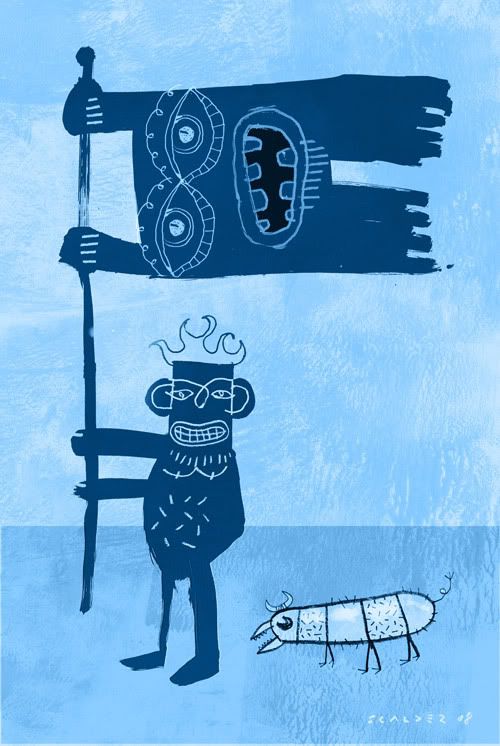
Synth Eastwood is a creative collective that's been putting some interesting multimedia shows on for quite a while now. Well worth checking out! This is an image I submitted for their recent flags & anthems show.

Friday, May 23, 2008

SING - its the weekend!


Yay! Funky Friday and the sun is OUT! Raise a holler so you know you're alive - rip the veils from yer eyes and set bravely forth into the tangled byways of Saturdayville (by way of your tipple of choice). Amach with ye!!!

The ONLY Irish band


Right now, this is IT! The new album from Republic of Loose and it leaves everything else on it's face, bleeding from the pores and streaming snot into the gravel. Standouts: Got, 23 Things I don't like, 13 Shots, I.R.I.I.S.H., I like Moosik and Mik Pyro's impression of Van on My Brain. Urrrrrrrrngh - Good God - they gotz the funk - and the stuff. Nothing else in the country comes close (excluding resident masked aliens and one chilly plucker of alt-victoriana). Isabel Reyes-Feeney is the illustrator who's created most of the ROL graphics (her vocals feature on the album too!) - check her work here.

Wednesday, May 14, 2008

The future of poetry magazines


Interesting article over on the Guardian Arts blog. "A whole new generation of poetry magazines is emerging," claims Todd Swift, Oxfam poet in residence and editor of the online anthology, Nth Position. Some interesting debate in the comments too!

Wednesday, May 07, 2008

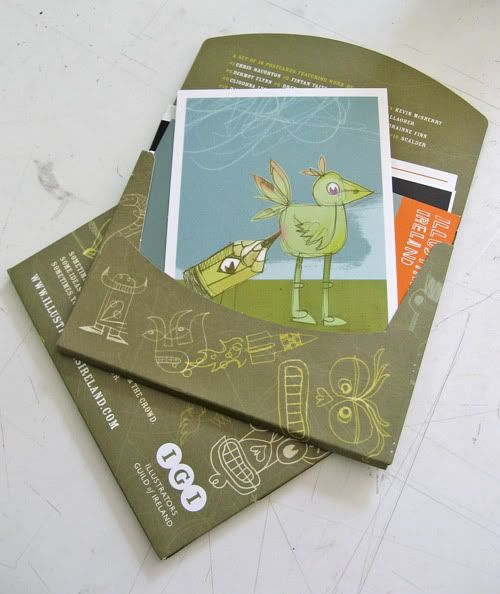
IGI Postcard Pack


If you're an art director in one of the leading UK ad agencies, design studios or magazine publishers you just might have received this wilful and uppity little pack of promotional cards recently, featuring 16 illustrators from among the ranks of the Illustrators Guild of Ireland.

I'm in there - and a bunch of my character dooooooods also adorn the pack itself, design courtesy of Artisan. If you haven't received one - and would like to..............tough - the whole print run has been sent, I'm afraid! But maybe drop the IGI a line, so they can include you on their next mailout - or maybe even invite you to some snazzy illustration-related event. Or not.

Scamperville Rendevous


Some nice stuff going up over on the Scamp blog these days.

Parp, Parp! (that's my own trumpet, you know).

Seriously though - I've some images over in this posting of recent work by IGI members and also in this posting of 'scamps' to 'welcome' our new 'leader' at the 'helm' (enough already!).

Also posted is a link to the fantabulous new website by fantabulous Irish illustrator Alan Clarke. I'm jealous of both the work and the snazzy website. I should get me one of dem lads. maybe. sometime.

Tuesday, May 06, 2008

Dublin Writers Festival 2008


Whoooop again! I've just been perusing the excellent line-up for this year's Dublin Writers Festival and have already booked my tickets for this event: Tobias Wolff and Anne Enright - Small Wonders: The art of the short story.

Tobias Wolff is probably my favourite living writer, in a lineage running from Hemingway - (I know, I know) - via Carver, so I'm hugely excited at a chance to hear him read / speak / whatever. Coupled with the currently omnipresent Enright, it should be a very interesting evening indeed. Plenty of other cracking events in the line-up, including some kind of evening with JP Donleavy? Pardon the confusion - its just that the programme blurb doesn't give much inkling as to what format to expect other than a 'special retrospective'? I'm a longtime fan of Donleavy's short stories and of The Ginger Man novel in particular, but have to admit I've found his increasingly 'stagey' persona somewhat cloying in latter years. Here's hoping the feet-of-clay factor doesn't come into play with Wolff.

I've pipedreamed before about attending the Creative Writing Program at Stanford, where not only Wolff, but Eavan Boland are on the Faculty (Colm Toibin has been a visiting lecturer there too, apparently playing a part in getting poet Brian Turner to Ireland after seeing him alongside Wolff, at an anti-war reading). So I noted with interest that Wolff's close contemporary Richard Ford has been signed up as adjunct professor in the School of English in Trinity College, Dublin. The Pulitzer Prize-winning novelist and short story writer will teach students of the MPhil in creative writing at the Oscar Wilde Centre for Irish Writing. There are some core similarities between the two Americans - Ford's lineage running a little more southerly, out of Faulkner and Flannery O'Connor. I've relished his short stories, but haven't been as enthusiastic as the broader audience about his Frank Bascombe trilogy. Having read the first book, The Sportswriter, I had enough of Mr. Bascombe to last me for quite a while. Not sure what that means - if anything. I'm sure I'll move on to the other books in the future and I'd be interested to hear what anybody out there thinks of these books - what am I missing here folks?